Some academic paths are linear, others unfold across disciplines. Professor Robert W. Schrauf’s journey into applied linguistics belongs to the latter. With a PhD in anthropology from Case Western Reserve University, a postdoctoral fellowship in experimental psychology at Duke University, and early faculty work in the medical school at Northwestern University, he did not begin his career in applied linguistics. He arrived there through an intellectual convergence of interests
“Anthropology is a four-field discipline”, he explains noting that linguistic anthropology first drew him towards language and that psycholinguistics deepened the engagement. A conference at the University of Bristol introduced him to applied linguistics. As one colleague told him, “You would like applied linguistics because half of the people in the room are linguists and half are psychologists…” The interdisciplinary balance aligned closely with the kind of work he had already been doing in bilingualism and aging.
It was at his first AAAL conference that he met Professor Sinfree Makoni, who encouraged him to bring his work on language and aging to Penn State. The move marks the beginning of a research trajectory that linked anthropology, psychology and applied linguistics, building on his earlier work on language and aging in medical research context.
Celeste Kinginger, Kirby Professor in Language Learning and professor of applied linguistics at Penn State, recently received the Modern Language Association’s (MLA) Kenneth W. Mildenberger Prize for her book, “The Professional Lives of Language Study Abroad Alumni: A Mixed Methods Investigation” (Multilingual Matters).

The Politics of Being Seen and Heard: A Conversation with Professor Ariana Steele
We all exercise some control over how others perceive us—through the way we dress, talk, and act. But what happens when others don't see us how we want to be seen? This question is at the heart of Dr. Ariana Steele’s research. Drawing on their expertise in sociophonetics, Dr. Steele investigates what’s known as the production-perception interface: the relationship between how we talk and how we are perceived. For speakers who are multiply marginalized, such as trans and queer people of color, speech perception can be high stakes. The degree to which a trans woman is perceived as feminine based on the way she talks and dresses can affect whether she is exposed to violence. Likewise, the perception of a Black speaker as aggressive can impact their interactions with police. Informed by Black feminist abolitionist perspectives, Dr. Steele goes beyond exploring linguistic responses to transphobia and anti-Blackness; they ask how and why people are categorized in the first place, and how we might abolish these oppressive systems.
Dr. Steele joined the faculty at Penn State as Assistant Professor in Fall 2024, and they were awarded the Gil Watz Early Career Professorship in Language and Linguistics in Fall 2025. They hope this endowed professorship will enable them to dig deeper into this research agenda and expand their work with their interdisciplinary research group, the Trans and Queer Terrains Lab (TQT). Hannah Lukow, Ph.D. candidate in Applied Linguistics and member of the TQT Lab, sat down with Dr. Steele to discuss their trajectory into sociolinguistics, how their work in community organizing and nonprofits informs their scholarship, the challenges of mixing quantitative and qualitative methods, and what upcoming projects they are excited about.

Dr. Jacob Rieker was awarded a University of Jyväskylä (JYU) 2026 Visiting Fellow Programme Grant. Hosted by Dr. Dmitri Leontjev (JYU, Centre for Applied Language Studies), Dr. Rieker will engage in research collaborations on the DD-LANG (Dynamic Diagnostic Language Assessment) project, which is funded by the Finnish government. As part of the one-month visiting fellowship, he will offer professional development workshops to Finnish in-service teachers as well as seminars on Vygotskian approaches to qualitative research methodology and EPPIC’s EMI initiatives to researchers and graduate students in the Centre for Applied Language Studies. This fellowship represents a valuable opportunity to further strengthen the international collaborative ties between JYU and PSU Applied Linguistics, EPPIC, and the CLA.
In a field often defined by carefully planned academic pathways, Dr. David Hanks, visiting Assistant Professor in the department of Applied Linguistics, embodies a very different story - one shaped by curiosity, openness and willingness to follow the unexpected. His path into linguistics was anything but conventional, yet it is precisely this unpredictability that has shaped him into the thoughtful scholar and teacher he is today.
This spotlight traces his journey from a circuitous educational beginning to his work in linguistic anthropology, language policy and education. This reveals a scholar grounded in humility, attentiveness and deep care for the human connections that make learning possible.
A Path Redirected by Curiosity
Doctor Hanks’s academic journey began far from linguistics. “I dropped out of high school”, he recalls, describing his early years with refreshing honesty but his interest in astronomy drew him back to Community College where he began taking general education courses. That's when a required language class (Russian), unexpectedly changed everything.
He found himself not only intrigued by the language but fascinated by the patterns, structures and reasoning behind it. “I realized I liked Russian, and I started taking almost a language semester, including Arabic, German, Mandarin, you name it”. But an even deeper shift was emerging: “I began to see that what I really liked wasn't just the languages themselves but the underlying mechanics of how language works”. That realization led him to linguistics. He eventually transferred to UCLA completed his bachelor's degree and began searching for ways to combine his interest in language with broader social questions. The search led him to Educational Linguistics at the University of Pennsylvania’s Graduate School of Education.
Finding Direction Through Theory and People
Graduate School became a turning point in his very first semester, he took an Indigenous education and language revitalization course that opened up a new intellectual horizon. He recalls sitting in a room surrounded by PhD students and thinking, “those were the conversations I wanted to be part of”. He was drawn to questions about how language interacts with identity, the political stakes of educational systems, how policy shapes linguistic opportunities and how communities negotiate language power and belonging. Scholars like Nancy Hornberger and Nelson Flores were formative influences, not because he had sought them out intentionally but because he remained opened to what he calls “serendipitous opportunities”
Research Rooted in Relationship
Perhaps the most compelling chapter of Dr. Hanks’s academic story begins with a plane ticket to Indonesia. This planned short exploratory trip, unexpectedly transformed into a major ethnographic project. “I was supposed to go to Bali for a couple of weeks just to see what was happening”, he explains, “but once there something shifted, I became deeply absorbed in the community, the language practices and the complexities of English medium instruction.” Suddenly the field site he hadn't planned on became the foundation of his dissertation. What made it meaningful wasn't just the research possibilities but the human relationships that grew around it. “I ended up forming close connections with local teachers and before I knew it, I had built an entire project out of the relationships that developed organically”. This experience reflects the core principle he now carries into all his work: scholarship is not simply about data, it's about the people who open their lives, classrooms and stories to the researcher. And for Dr. Hanks it is that dimension that makes scholarly work matter.
A Warm Welcome into The Penn State Classroom
Transitioning into Penn State as a Visiting Assistant Professor has been in his words an “unexpectedly smooth and energizing experience”. He speaks with enthusiasm about the students he has met, students who are in his view engaged thoughtfully and eager to interrogate the complexities of language. “It's encouraging to walk into a classroom and see how willing students are to engage with each other”, he says. “Their enthusiasm mirrors my own excitement. It's a kind of feedback loop." He emphasizes the importance of building a classroom community where students learn not just from the instructor but from each other. It is this collaborative energy, mirroring his own research ethos, that makes teaching for him a source of genuine joy. Being part of the Penn State Applied Linguistics community has also been affirming. He describes the department as supportive, welcoming and intellectually invigorating - a place where his interests can grow and branch in new directions.
Advice To Students and Early Career Scholars
When asked what advice he would offer to students entering applied linguistics, Dr. Hanks leans into the wisdom shaped by his own journey. “Cast a wide net”, he says. “The field is vast and deeply interdisciplinary: linguistic anthropology, sociolinguistics, language policy educational linguistics, critical applied linguistics. Anyone of them can become a home.” He encourages students to allow their interests to evolve rather than force themselves into a narrow lane too early. He also emphasizes the importance of relationships: “talk to people! Build networks! Ask questions! Most of the opportunities I've had, came from conversations I didn't expect to be important”. In other words, stay open both intellectually and interpersonally. That openness he suggests “is what allows scholars to notice the opportunities that crossed their path and to follow them in meaningful ways”.
A Scholar Grounded in Openness and Care
Looking across Dr. David Hanks’s journey - from dropping out of high school to a multilingual explorer, from language enthusiast to ethnographer working in Bali and now to Visiting Assistant Professor at Penn State, one theme stands out: his commitment to staying open to possibilities. His path has never been linear, but it has been deeply intentional in its own way: guided by curiosity, achieved by human connection and strengthened by willingness to follow ideas wherever they lead. And it is precisely this spirit that enriches the teaching, research and community he brings to Applied Linguistics at Penn State.
By Rose Asantewaa Ansah
(RA, Head of Department)

In the ever-evolving field of Applied Linguistics, Professor Celeste Kinginger, who has recently been named Kirby Professor in Language Learning, spent her career illuminating the lived human experiences at the heart of language learning. As a pioneer in virtual exchange, study abroad research and narrative inquiry, she has shown that learning another language goes beyond an academic exercise. It is a way of seeing, feeling and engaging with the world.
Behind her achievement lies a story of resilience, curiosity and gratitude - a lifelong commitment to helping learners discover not just new languages, but new ways of being in the world. This spotlight celebrates that journey and the enduring impact of her work.
A career rooted in Gratitude and purpose
When Professor Kinginger first heard she had been named Kirby Professor in Language learning, her first response was gratitude. She thought of the people and moments that had shaped her love for languages: “My parents never questioned my desire to pursue a language-related career” she recalls, “and they sent me abroad while I was still in high school. Then came a glittering cast of teachers who each inspired me in their own way”. From a high school French teacher who turned adolescent energy into creative theater project to a college mentor whose mysterious career she only understood through the books she left behind, Kinginger’s early experiences revealed that languages open more than grammatical systems-they open worlds.
Navigating Earlier Challenges
The early stages of Professor Kinginger’s Career were full of movement, uncertainty and resilience. Significant among these was how she juggled teaching positions across institutions while raising a young child and sometimes wondered if she should abandon academia entirely. “There were certainly moments when I began to suspect that the easiest solution would be to abandon any hope of crafting an academic career”, she admits. Her sense of purpose was rekindled with encouragement from colleagues such as Claire Kramsch and members of Jim Lantolf’s Sociocultural Theory Working group. Feeling stifled by conventional classroom routines she began action research, experimenting with early versions of Virtual exchange and videoconferencing. These innovations led to her first major publications, among which one of them earned a national honor.She later joined Penn State’s Department of French in 1999, and her arrival coincided with the founding of the Center for Language Acquisition. She recalls, “Suddenly, some of the people I had previously travelledlong distances to see were my colleagues” and surprisingly, “I had walked into a group of highly accomplished, likely-minded scholars willing to collaborate”.
Defining the Meaning of the Kirby Professorship
For Professor Kinginger, the Kirby Professorship is more than recognition. To her, it affirms her lifelong mission to make language meaningful for American students, many of whom may view it as “a vacant academic exercise with little application in adult professional life”. She believes this narrow view “impoverishes the education we provide” and overlooks how language learning can “re-mediate one’s interaction with the world and with one’s own Psychological functioning.”
Over the years, her research has consistently explored this transformative side of language. Her early studies dived deeper into opportunities for real communication in language classrooms. She later worked with the Telecollaboration Project, funded by the U.S. Department of Education to link students at Penn State with peers in France, Spain and Germany. “Our research showed that the virtual classroom can be a rich environmentfor the development of pragmatic capabilities necessary for everyday interaction”, she explains.
Finding an intellectual Home
At Penn State, Professor Kinginger found an environment that reflected her interdisciplinary curiosity and belief in collaboration. The Department of Applied Linguistics, she says, is “a remarkable environment for research on language learning because there is none of the discord that in my experience can characterize other groups”. She describes the department as a place where “each faculty member is entirely free to explore and expand their purview as far as their imagination will take them without censure from others. We trust and support each other because we know that every colleague has a stellar reputation in the field for innovative, relevant, high-quality scholarship.” What makes the department exceptional, she adds is its collegiality and shared purpose. “There is a profound sense of shared mission to produce research with social impact; everyoneis fully engaged – and very busy – with the business of conceiving, developing and sharing these insights. This means that there is no time for destructive gossip, undermining of others’ reputations, or arguments about what sort of work does or does not count as legitimate under the banner of ‘linguistics’.” The spirit extends to mentoring. “Our PhD students are highly skilled and driven to address the social injustices they have witnessed in their own careers”, she notes. “it’s deeply rewarding to see them connect scholarship with social impact”.
Narrative, Pragmatics and the Human side of Language
Over time, not only did the study abroad experience become Kinginger’s priority, her interest in pragmatics also grew stronger, where she started to examine how linguistic and cultural learning unfold in everyday life. In collaboration with colleagues and students, she conducted detailed analyses of the homestay dinner table in China and France, demonstrating how language development intertwined with food, manners and moral values. Kinginger’s intellectual path has always blended theory and narrative. Her early love for literature evolved into a powerful attraction with case study and narrative research. “I wanted to understand the lives of language learners”, she explained.
Looking Ahead as a Kirby Professor
As a Kirby Professor, Kinginger hopes to return to a long-standing theoretical curiosity: the Vygotskian concept of perezhivanie (lived experience). “It captures two dialectic unities”, she explains, “Cognition-emotion and the mutual influence of the person and social environment”. By linking this concept to narrative research, she aims to show how dramatic events shape both psychology and learning
Looking back, Professor Kinginger’s story is one of curiosity, resilience and faith in the transformative power of language. From her early fascination with literature to her leadership in virtual exchange and narrative inquiry, she has continually shown that language learning is above all, a human encounter - an act of empathy and imagination.
Her journey reminds students and colleagues alike that to learn a language is to learn to see the world anew. It is this enduring vision and the impact it has on learners across decades that makes her recognition as Kirby Professor in Language Learning not just an honor but a deeply well- deserved affirmation of her life’s work.
(By Rose Asantewaa Ansah)

In the dynamic field of Applied Linguistics, few names resonate as deeply as Professor Sinfree Makoni. Known for his pioneering work on decolonial sociolinguistics and Southern epistemologies, Professor Makoni has spent decades reshaping how language, identity, and power are understood in both the Global North and South. His career, which has taken him from Zimbabwe and Ghana to Edinburgh and Penn State, reflects not only an impressive scholarly journey but also a lifelong commitment to challenging dominant narratives and amplifying marginalized voices.
Beyond his extensive research, publications, and leadership, Makoni stands out for his humility, compassion, and collaborative spirit. He embodies the essence of Ubuntu, the African philosophy of interconnectedness, making scholarship not just his profession, but his way of life. In this spotlight, we trace his academic path, inspirations, and the principles that continue to guide his work and his students.
A Global Journey of Scholarship and Purpose
Professor Sinfree Makoni’s academic journey began in Zimbabwe and has since traversed several continents. He holds a BA in English and Linguistics from the University of Ghana and a PhD in Applied Linguistics from the University of Edinburgh, where he studied under Professor Alan Davies. His academic and professional trajectory has taken him through several African universities including the University of Swaziland, University of the Western Cape, University of Cape Town, and the University of Michigan before joining Pennsylvania State University (PSU) in 2002.
He describes this cross-continental career as a “complex intellectual nomadic trajectory,” one shaped by diverse social and political experiences in Africa, Europe, and North America. These experiences, he explains, “shaped my theoretical orientations towards critical approaches in Applied Linguistics, such as decolonial sociolinguistics and southern epistemologies.”
Shaping Scholarship and Leadership at Penn State
At PSU, Professor Makoni plays a pivotal role in bridging disciplines through his appointments in Applied Linguistics and African Studies. He currently serves as Director of African Studies, a position through which he has spearheaded several transformative initiatives. Among his most notable achievements is the establishment of the dual-title doctoral program in Applied Linguistics and African Studies, which he describes as a step toward uniting knowledge systems across regions and traditions. As he explains, the program “brings together thinking and scholarship from North and South without prejudice, with equal validity”.
He also leads the African Studies Global Virtual Forum (GVF), a digital platform that connects scholars from around the world in critical conversations about decoloniality, language, and knowledge. The GVF, in his words, “problematizes the hegemony of the Western canon in favor of pluralistic concepts of language, discourse, and communication.” For Makoni, leadership and scholarship are intertwined. “Occupying administrative roles,” he notes, “is not simply bureaucratic; it’s a way of recognizing and amplifying silenced intellectual voices”.
Collaboration as a Way of Life
For Makoni, the most rewarding aspect of his work is the collaborative spirit that defines his scholarship. His approach to academia is rooted in Ubuntu, the African philosophy of interconnectedness and shared humanity. He sees his life and works as inseparable, observing that “my life is scholarship and scholarship is my life”. He views every research partnership and mentorship as an opportunity to learn from others and to create spaces where intellectual and human growth coexist. His life, he said, “is communal, spread across other people’s intellectual activities, and collaboration has been the touchstone of my scholarly experiences.”
Preparing Students for the Future
In teaching and mentoring, Professor Makoni emphasizes inclusivity, interdisciplinarity, and critical awareness. “My pedagogical philosophy centers on preparing students to think beyond established norms and to recognize the global dimensions of linguistic study. Initiatives like the Global Virtual Forum and the dual-title doctoral program, provide platforms that empower students, especially from the Global South to participate in global academic conversations. “I aim to bring down the political, economic, geographical, and gender barriers of the scholarship arena”.
Wisdom for Emerging Scholars
After decades of teaching and collaborating across continents, Professor Makoni has distilled his advice for young scholars into a lesson both simple and profound. For him, academic life is not just about mastering texts but about understanding people.
For Makoni, scholarship is “a world of strangers,” and the task of the scholar is to transform those strangers into collaborators. He continues, “To be a good scholar is not only to be able to read books, but to be able to read people. “Universities teach us how to read books,” he says, “but they don’t teach us how to read the human condition. Yet it is only by reading human conditions well that you can create an environment that enables you to truly read books.” This is a striking piece of wisdom - that intellectual growth is inseparable from emotional intelligence and empathy
As he reflects on a career that has spanned decades and continents, returning soon to the University of Edinburgh to receive an Honorary Doctorate of Letters, Makoni sees this philosophy come full circle. His journey from being a young student navigating new spaces to becoming one of the most respected voices in global applied linguistics, underscores the essence of his advice: Scholarship is a communal journey of learning from, and with others.
(By Rose Asantewaa Ansah)

This Friday, October 3, 2025, the Center for Language Acquisition will host Ashely Moore for the Invited Speaker Series. This event will begin at 2:30p.m. in 158 Willard Building. See the hyperlinked flyer and the information below for more details about the event.
Invited Speaker FA25 Ashley Moore
Title:
“I didn’t see being gay as an experience that could unfold in Arabic”: Homophobia, linguacultural ideologies, and coloniality in the emergence of linguistic dissociation among some queer plurilinguals
Abstract:
Linguistic dissociation is an intersubjective process through which language users distance themselves from previously acquired linguistic resources because those resources have become entangled with, and subsequently come to connote, contrasubjectivity—the experience of significant conflict between one’s sense of self and one’s social environment (Moore, 2023). As linguistic resources become associated with contrasubjective experiences, I theorize that a particular kind of affect, undesire, adheres to them. The mirror image of desire (Motha & Lin, 2014), undesire is characterized as an excess, “a surplus of something that we can no longer bear to keep within our bodily horizon because of the contrasubjectivity it connotes” (Moore, 2023, p. 1165).
In this presentation, I will use data from my own studies (Moore, 2013, 2022, 2025a, 2025b) and other scientific and literary accounts (e.g., Al-Solaylee, 2021; Espín, 1999; Harrison, 2011) to show how, for some queer plurilinguals, L1-mediated societal homophobia acts as a source of contrasubjectivity generating sufficient undesire to compel them to distance themselves from their L1. However, while acknowledging the reality of the homophobia they have experienced, I also argue that their accounts often bear traces of linguacultural ideologies that can be seen to further condition their affective relationships with the named languages in their repertoires, e.g., believing queerness and Arabic to be fundamentally incompatible. In some cases, these linguacultural ideologies are rooted in and perpetuate (neo)colonial logics and, from a critical realist perspective, I contend that we might interrogate their veracity. Arguing that undesire and linguistic dissociation can also be powerful drivers of foreign/second language learning, I conclude by discussing the implications of the foregoing for language education.
Bio:
Ashley R. Moore is an Assistant Professor of Language and Literacies Education at the Ontario Institute for Studies in Education (OISE), University of Toronto. His research program includes strands on linguistic dissociation, queer/trans issues in language education, and critical realism. His recent work has been published in Applied Linguistics, TESOL Quarterly, Research Methods in Applied Linguistics, and the International Journal of Bilingual Education and Bilingualism.
Penn State’s Department of Applied Linguistics continues to stand out globally, with six of its faculty members ranked among the top 2% most cited scholars in the world, according to the latest to statistics compiled by Stanford University professor John P.A. Ioannidis and available through the Elsevier Data Repository. The scholars—Suresh Canagarajah, Xiaofei Lu, James P. Lantolf, Karen E. Johnson, Matthew E. Poehner, and Tommaso M. Milani—are recognized for their groundbreaking contributions to key areas of applied linguistics, including translanguaging, corpus-based approaches to language learning, critical discourse analysis, second language acquisition, teacher education, and Vygotskian-inspired dynamic assessment.
This continued recognition highlights the department’s sustained excellence in research. The Stanford list, which evaluates scholars based on citation metrics, affirms the global relevance and impact of Penn State’s applied linguistics research.
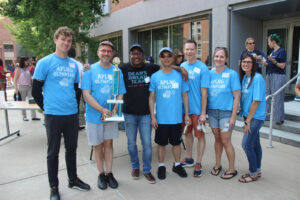
Faculty and staff in the College of the Liberal Arts participated in the college's annual Office Olympics last week. In addition to competing in several events, the Department of Applied Linguistics won the fundraising trophy for helping to raise more than $3,000 for Centre County United Way!